
Unconventional Careers After a Journalism Degree

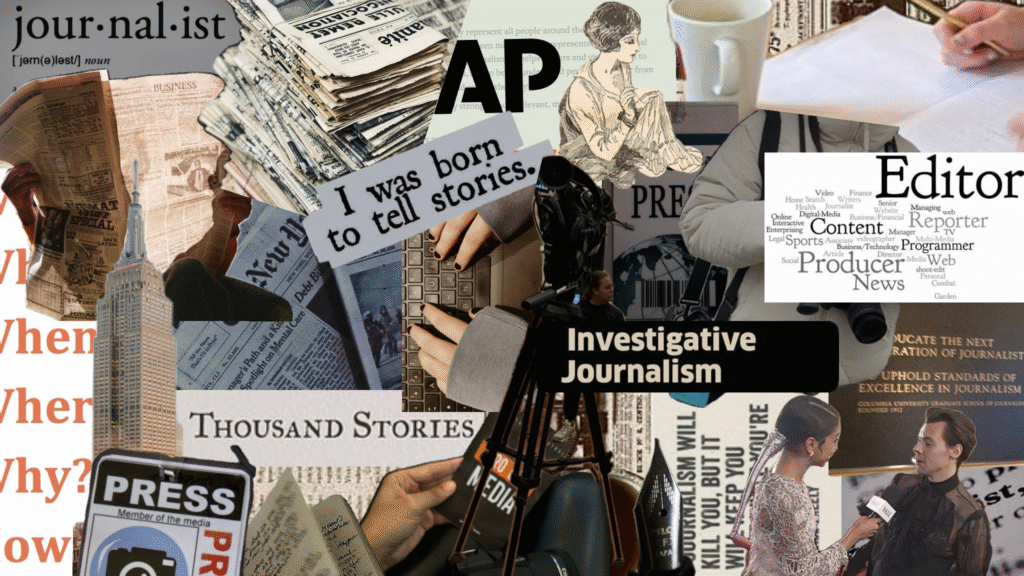
Unconventional Careers After a Journalism Degree
"Your degree taught you to tell stories. Now let it take you places the newsroom never could."
Ask someone what a journalism degree leads to, and they will almost certainly say: news reporting. A desk at a television channel, a byline in a newspaper, a microphone in hand outside a press conference. That image is not wrong — but it is dangerously incomplete.
Having spent over a year working at the intersection of journalism and strategic communication, I can tell you this with confidence: the skills this degree builds are among the most versatile in any professional landscape today. The problem is that most of us are never told that.
So here is what I wish someone had laid out clearly before I graduated — a map of the roads that open up when you hold a journalism degree and know how to use it.
Corporate Communications & Public Relations
This is perhaps the most natural — and most underestimated — pivot for journalism graduates. Every organisation, whether a startup, a listed company, or a government body, needs people who can manage how it is perceived by the world. That is the job of corporate communications.
Roles like PR Executive, Communications Strategist, and Media Relations Manager sit at the heart of this field. They require you to craft messaging that is clear, credible, and strategically timed — which is precisely what journalists train for every day.
💡 What makes journalism graduates stand out here?
- You already know how journalists think — so you can anticipate what the media will ask
- You are trained to write under pressure and communicate without jargon
- You understand narrative framing — the ability to shape how a story is told, not just what it says
"In PR, you are not leaving journalism behind. You are applying it — just for a different kind of audience, with a different kind of brief."
Digital Content Creation & Content Strategy
The internet has made content the currency of every business — and businesses are spending serious money to produce it well. Behind every brand blog, LinkedIn newsletter, YouTube script, and email campaign is a professional who knows how to write with purpose.
Journalism graduates are exceptionally well-suited for roles like Content Writer, Editor, SEO Specialist, and Content Strategist. The training is directly transferable: you already know how to research a topic thoroughly, structure information so it holds attention, and write in a voice that actually reaches people.
Research First, Always
Good content, like good journalism, starts with knowing your subject better than your audience does.
Structure Is Everything
Inverted pyramid, storytelling arc, or listicle — choosing the right format for the right platform is a skill, not an afterthought.
Data Backs the Story
Content strategy uses analytics the same way journalism uses sources — to verify, to guide, and to make better decisions.
Know Your Reader
Audience understanding is the most underrated skill journalism gives you — and the most valuable one in content marketing.
Broadcast Media & Production
There is a widespread assumption that broadcast careers are limited to on-screen reporting or anchoring. The reality is that television, radio, OTT platforms, and digital video channels run on an entire ecosystem of roles that never appear on camera — and many of these are more intellectually demanding than the ones that do.
Producers, Scriptwriters, Video Editors, and Researchers are the backbone of any broadcast operation. These professionals decide what gets told, how it gets told, and whether it is told well. That is journalism — applied through a lens and a timeline instead of a column inch.
🎥 Roles worth exploring beyond the studio
- Documentary Producer — long-form storytelling that rewards deep research and editorial rigour
- Podcast Writer & Producer — one of the fastest-growing formats for in-depth journalism
- Scriptwriter for non-fiction video — explainers, investigations, and branded content all need structured scripts
- Broadcast Researcher — the invisible engine behind every well-sourced television feature
"The story is the same. Only the medium changes. And journalism trains you to serve the story — not the format."
Media Research & Analytics
This is a career path that barely existed a decade ago and is now growing faster than most journalism graduates realise. As organisations increasingly rely on audience data to make editorial, strategic, and commercial decisions, they need professionals who can read data and translate it into insight.
Media research agencies, think tanks, and in-house digital analytics teams offer roles that combine the rigour of journalism with the logic of data science. You do not need to be a statistician. You need to ask the right questions — which, if you have been trained as a journalist, you already know how to do.
🧩 The journalism–analytics overlap is stronger than you think
Journalism trains you to verify information, spot patterns, question assumptions, and present findings clearly. These are the same skills that make a strong media analyst. The difference is the tool — spreadsheets and dashboards instead of notebooks and sources.
Advertising & Brand Storytelling
Advertising, at its core, is storytelling with a commercial objective. And brand storytelling — the art of making an audience care about a company's values, mission, or product — is journalism with a different brief.
Copywriting, Creative Direction, and Campaign Planning are all disciplines that draw heavily on the skills journalism cultivates. The ability to write a headline that stops someone mid-scroll, to construct a brand narrative that feels genuine, or to identify the emotional truth in a product's story — these are not advertising skills. They are journalism skills, redirected.
Copywriting
Every great copy line is a miniature story — a problem, a tension, and a resolution in ten words or fewer.
Creative Direction
The best creative directors think editorially — they know which story to tell and which angle makes it land.
Publishing & Editorial
Magazines, books, and digital publications continue to offer editorial roles that are a natural home for journalism graduates.
Campaign Strategy
Understanding what an audience believes and feels — before telling them something new — is the foundation of both journalism and effective campaigns.
Independent Media & Entrepreneurship
Perhaps the most exciting development of the past decade is the rise of the independent media professional. The tools to build an audience, publish at scale, and monetise original content are now accessible to anyone with a laptop and a clear point of view.
Journalism graduates are building careers as Freelance Writers, Podcasters, YouTubers, Newsletter Creators, and Substack contributors — often reaching audiences larger than many traditional publications. This path demands something different from institutional journalism: you have to be the reporter, the editor, the distribution team, and the business all at once.
📌 What this path actually requires
- Audience development skills — understanding how to grow and retain a readership
- Business fundamentals — pricing, partnerships, sponsorships, and sustainable revenue models
- Consistency over perfection — independent creators succeed through reliability, not occasional brilliance
- A defined editorial identity — readers follow a voice, not just a topic
"Independence in media is not freedom from all constraints. It is the freedom to choose the constraints that align with what you actually want to say."
The Degree Is a Foundation — Not a Ceiling
A journalism degree does not guarantee you a career. No degree does. What it gives you, if you pay attention, is a set of foundational professional skills that travel well across industries: the ability to research deeply, communicate clearly, think critically, and tell stories that people actually want to engage with.
The graduates who go far are rarely the ones who waited for the perfect journalism job to appear. They are the ones who recognised that their training was broader than their degree title suggested — and acted on that early.
🌟 What I would tell every journalism graduate today
- Your skills are more transferable than you have been told — start believing that
- Digital competency is no longer optional — build it alongside your editorial skills
- The media industry is broad; your career path within it does not have to be narrow
- Find mentors who have navigated non-traditional paths — their experience is often more useful than conventional career advice
The newsroom is one destination. It is a good one. But it is not the only one — and for many journalism graduates, it may not even be the best one.
Want to Learn More From Sujal Sharma?
Connect with Sujal directly — explore his journey in media and strategic communication and get guidance tailored to your career path.
👤 Visit Sujal's Profile →



Responses