
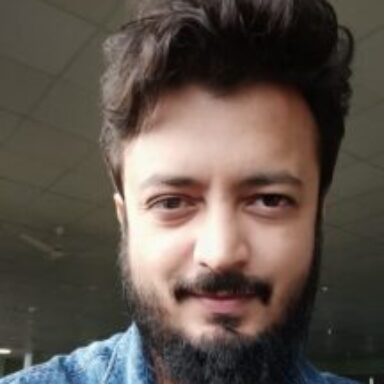
Sadaf Madni
You must login to add a review.
Pricing & Availability
599
Personal and Professional Details
I am a theoretical physicist with a PhD in High Energy Physics from the National Institute of Science Education and Research (NISER). My research focuses on the properties of quark–gluon plasma, with four peer-reviewed publications in leading international journals such as Physical Review D and Physics Letters B. I have over two years of experience teaching undergraduate courses in relativity and particle physics, along with mentoring research students. Having qualified national-level examinations including JEE, GATE, NET, and JEST, I understand both the academic rigor and the strategic preparation required for competitive pathways in science. Alongside research, I founded a STEM coaching initiative for school students, reflecting my commitment to structured, concept-driven learning and long-term academic growth.
Sadaf
Madni
smadni
PhD (High Energy Physics); NISER – Batch 2019-2025
Physics of Quark Gluon Plasma
B.Sc (BHU; 2013-2016; PCM); M.Sc (BHU; 2016-2018; Physics Hons.); PhD (NISER)
English, Hindi, Urdu
Qualified NET, JEST, GATE, JEE
Experience
WordPress, Mathematica, LaTeX, Public Speaking
2
Self Employed
Start-up Founder
Social and Mentorship
The biggest myth about physics — especially high-energy theory — is that it’s all brilliance and breakthroughs. The reality? It’s patience, isolation, and long stretches of not understanding what you’re doing. Research is 80% confusion, 15% debugging calculations or code, and 5% actual insight. Publications don’t come from “genius moments.” They come from months (sometimes years) of refining one calculation until it survives peer review. Rejections are normal. Self-doubt is normal. Slow progress is normal. As for exams like JEE, GATE, NET, or JEST — they don’t just test intelligence. They test consistency under pressure. The students who clear them aren’t always the smartest; they’re the most disciplined and strategically prepared. No one tells you this early enough: talent helps, but structure, emotional resilience, and long-term focus matter far more.